Pages

Showing posts with label writing. Show all posts

Sunday, February 10, 2013

The Big City Gets Bigger

In the best possible way, Kuala Lumpur is quirky. It is stores like "Goo Goo Wonderland" (in English: Party Depot) and dishes that bear the title of "supreme," and candy shops called "Chocolate Kingdom." It is open-air markets with smells wafting and stinging the nose, and residents whose direction-giving abilities rival only the Romans. It is flashy shopping malls with more designer shops than Fifth Avenue, and then a million knockoff stands fifty yards around the corner. Most important, though, it is corporations whose taglines claim the effort of companies rather than the quality of them: the Pavilion Mall calls itself "The second-best mall in Southeast Asia;" a coffee shop brags that it is "striving" to make the best coffee in KL; even Kuala Lumpur itself claims to be "on its way" to becoming Asia's most important city.

A woman getting street food in Kuala Lumpur
We are surrounded by storefronts, shopping malls, restaurants that boast not what they are but what they hope to become, advertising their aspirations just below their names. We are surrounded by en-route-ness, by not-yet-ness, by still-trying-but-fear-not-it-will-happen ambition. Yes, KL is plenty quirky, but its refusal to nonchalantly accept complacency is contagious. As a fellow Fulbrighter reminded me, "This city is still a baby." It is growing. And we have found ourselves in the middle of its becoming, building, bettering glory.

The Petronas Twin Towers
Could anyplace be more appropriate for us newly-arrived Fulbrighters? We, too, all seventy-five of us, are working to realize lofty (but entirely possible!) aspirations. We are teachers, advocates, writers, scientists, researchers, learners. We, too, are becoming, building, and bettering; not focusing outward and posting it on billboards as is KL, but working just as adeptly on an internal level, a level that can only be understood personally. We have been in Kuala Lumpur for two days, long enough to achieve jet-lag and a vague familiarity with the city. Our Fulbright grants are now beginning. I can't wait to see what these next ten months of teaching and learning, of building, becoming, bettering Kuala-Lumpur-style, will bring.

A mosque in downtown KL

Tuesday, June 26, 2012

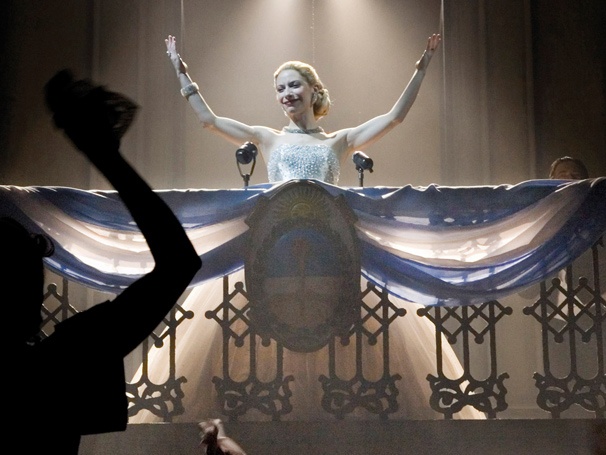
Evita

I was apprehensive about seeing Evita this past Friday. I had heard a lot of gripes about the production, and about the lead actress's, Elena Roger's, voice. Roger definitely had an Edith Piaf quality, so much that I was yearning for "La Vie en Rose" by the time "Don't Cry for Me" rolled around. I have an even bigger gripe than her voice quality, though, and that is the very strange accent in which she sang. For most of the show, she sounded French to me, and, at some points, her husband sounded Scottish! My friend and I were humming "Where in the World Is Carmen San Diego?" to each other during interludes; those actors did NOT sound like they were in Argentina. My friend, Greg, made a good point about this singing-in-accent ordeal when he noted that Shakesperian productions, though often set in Italy, are written and performed in English not Italian. Isn't that the beauty of them? Thank God Shakespeare wasn't trying to throw in Italian catchphrases or, worse, having Romeo flip his R's. I'm not sure why this director thought otherwise, especially since Roger is Argentinian, and her debut role was as Evita Peron (!!!) in earlier production.

Image c/o googleimages.com
As far as other gripes go, there was a major lack of narrative. They were highlighting moments of Evita's life rather than giving a fluid story, which was confusing (to the point where I thought she was a promiscuous person, not a paid prostitute, for a good portion of the show). Also, I was not at all impressed with Ricky Martin, although Greg was raving about his performance. And, about singing everything, I'm not a huge fan of that, either. Apparently, Evita is marketed as a "rock-musical" (bad bad bad bad idea), which puts the show in the tradition of Rent, Spring Awakening, and Next to Normal. Audiences who are not comprised entirely of angsty, fifteen-year-old girls will probably find the style of all of these shows to be really terrible, as they should. 
Image c/o googleimages.com
Now that I've complained extensively about the show, I guess I should admit that I didn't hate it. In the end, I walked away with an absolute fascination with Eva Peron, who I knew nothing about prior. I've already read her entire Wikipedia page and will probably take out a few books on her life because I'm confused, and intrigued, and amazed. And I think that's exactly what the show was trying to do.

Monday, April 30, 2012

Revelations in the Key of R

I am the alphabet backwards
If R didn’t exist, I never could have.

On alliteration homework assignments,
I wrote my name next to generous, genuine, gregarious
All obtuse
R worked in the shadows:
Radiant, reflective, resolute .

Royalty, strangers called me.
I perfected my name’s soft curves,
I referenced a different history altogether.

The rhythm of my family pulses in my middle
It punctuates my symphony with a slow movement
It reminisces of my ancestors’ voice
Now lost under six feet of another country’s dirt
Better they don’t know.

Better they rest in unvisited tombs
Their deaf ears hardened
To crashing waves and thick Italian
Their hardwood caskets
Forever adorned with an immortal Rose.


(Inspired by Mary Karr's "Revelations in the Key of K")

Saturday, February 25, 2012

Writing, anyone?

I went to the MoMA today, and spent a lot of time in the Sweet Violence exhibit. It amazed me. This piece, -tentatively- titled Who Calls You Beautiful?, came from it.

You are wearing Gucci sunglasses that draw attention to your perfectly sculpted cheekbones, and I am wondering, “Who calls you beautiful?”
You are pictured on a black couch, sexy, smoking a cigarette.
You are posing for a camera, naked, splashing water onto your face.
You are bathing, radiant, under magazine-heading text that reads Risveglia la tua pelle!
You are brushing onto your cheeks rouge that conceals scars.
You are painting the image of your child, perfect and happy, smiling in a bubbly tub.
You are showing your pregnant belly in front of a window filled with light.
You are whipping egg whites, your cherry-patterned apron tied tightly around your waist as you stir in a cup of sugar.
You are wearing Gucci sunglasses that draw attention to your perfectly sculpted cheekbones, and I am wondering, “Who calls you beautiful?”

Monday, February 6, 2012

Love, Loss, and What I Wore

Love, Loss, and What I Wore puts love and loss at center stage. The show features four women who go through multiple marriages, come out, lose their mothers at young ages, get raped, and more: all of life's worst bestowed on this small sample population. Veanne Cox and Lillias White deliver convincing performance, but the show's handicap is in the script, not the acting. While the actresses harp on their crises, the audience craves meaning in stability.

Perhaps the "what I wore" aspect of the show is meant to deliver the consistency so lacking in the leads' lives. However, the joyful, creative element of style is reduced to superficiality as the women put so much emphasis on that wrap dress or those suede boots. After sitting through one too many monologues about a purse, it behooves the audience to ask why the people in their lives then aren't given as much value as the material things these women adore. We yearn to see their fashion-centered romance and devotion play out in their human relationships, we hope that the play will conclude on this happy high, but such affection never leaves Filene's Basement.

Surely, the goal of Love, Loss, and What I Wore is not to expose a bunch of superficial ladies who have their priorities screwed up. It probably hopes to empower women. However, LLWW forgets that empowerment is a human phenomenon, one that requires a lot more than the occasional mention of fashion.

Tuesday, January 3, 2012

Surprises

2012 is upon us, and I have some pretty big items on this year's bucket list. Graduate College. Get TEFL certification. Travel like mad. Things of that nature.

Oh, and, of course, write until my pens run out of ink. Buy more pens. Continue writing.

On New Year's Eve, Neil Gaiman posted on his blog some advice that I found inspiring. He talks about creativity, the power of love, intentional kindness.

I got into reading Gaiman's wishes from new years past (which, by the way, are now old years, ha!). And, harking all the way back to 2001, I saw in front of me a goal that was already at the top of my bucket list:

"May your coming year be filled with magic and dreams and good madness. I hope you read some fine books and kiss someone who thinks you're wonderful, and don't forget to make some art -- write or draw or build or sing or live as only you can. And I hope, somewhere in the next year, you surprise yourself."

Surprising myself. A big goal for 2012.

I hope that you, too, surprise yourself in 2012. I hope you laugh with abandon. I hope you see beautiful things. I hope you love richly, in spite of yourself, when it isn't deserved, when it's inconvenient for you.

Here's to our best year yet.

Monday, January 2, 2012

Startin' Off the New Year Right

I thought I might start off the year with some writing. Really, could there be a better way to welcome 2012??
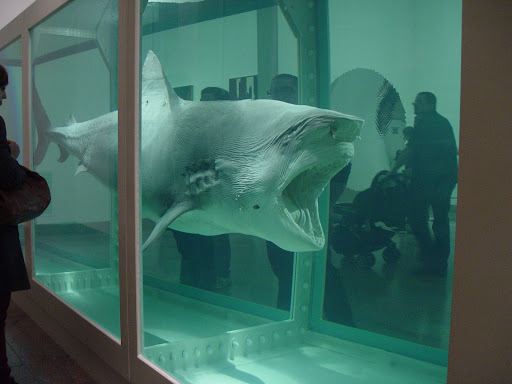
This is called The Physical Impossibility of Death in the Mind of Someone Living; it's a meditation on Damien Hirst's exhibit by the same name. I got to see the exhibit at the Met and it was awesome.

Image c/o googleimages

Silence. Blood rushes to the ears and brain and quickly flows to the nose, chin, fingertips. Reality vanishes. There is pulsing, a hard pounding from within and, simultaneously, from the skies. Pounding rises from the ground. The heavy air throbs. Yellow taxi cabs and eclectic lighting, the smell of spicy, exotic foods and the hum of crowds are all drowned out of existence. Bright blue thickness surrounds, submerges, engulfs; it is vibrant like the neon advertisements of Times Square, overwhelming like the horns of taxi cab cars, tangy like the flavor of Little India’s ginger, though it is also acidic, stinging, viscous.

Removed from the busyness, a stranger stands in the still water of formaldehyde. He is silent, motionless. Open-mouthed and obscure under a grey coat of collagen, he is suspended. He does not breathe. He makes no sound. His eyes do not blink. Triangular razors jet out of his body; he is built to glide, to puncture. He is water-resistant and oblong and pointed. He does not swim. His jaws are large with sharpened teeth and opened nose holes. He does not sense. He acknowledges no existence. His sandpaper skin has turned to softness. His eyes are blinded and his blades are dulled. He is paralyzed by his vivid ocean, but he remains indifferent. He is encased. He is defeated. There is no threat.

Reality returns.

Monday, December 5, 2011

Apologies All' Improviso

We had an improvisation workshop in my creative writing class today. This came out of it. Nothin' like some improv to fuel my creative writing.


I'm trying to be strategic. Ten stubby fingers dancing across eighty eight keys. This is what it feels like to be on display, I think, even though I'm in a stuffy closet filled with pianos, just me and my Asian piano teacher.

There are a million ways to go. Eighty eight times eighty eight amounts to 7744 possibilities, plus 7744 times 7744 more when you add in grace notes, trills, passing tones and suspensions. A million little hammers sending vibrations through a million little strings to create sound, as a million doors open to a million possibilities, all painted white and black, alternatively. It occurs to me that I'm not choosing any of them particularly well.

At some point, you just have to go. When everything comes to a halt, all of my blood cells and tendons at once resting, all six nameless figures in the dark room stopped, impulse takes over. A hand raises. A foot jolts forward. My fingers begin to dance.

"Fuck!" I scream when I mess up, and my piano teacher winces. One of the figures falls forward, all bones swathed in blue. A friend once suggested to me that I ought to own my mistakes, never apologizing for them but celebrating them instead. "I'm sorry," the blue figure inside of me says, as she recomposes herself off of the wooden floor that has risen out of itself. She heads toward another door...

Doors. Doors rise out of the floor now, long wooden panels bathed in black. And the figures inside of me are hastening to make their way through them, worlds of possibilities: a seventh chord here, an augmented chord now.

What would it be if we understood the world through music? All of our fingers dancing across black and white keys, constructing black walls from impulse, maneuvering around obstacles suddenly risen.
Creating worlds of harmonies and dissonances in spite of ourselves.
Never apologizing when we fall.


More improv-inspired writing after the jump.

Friday, November 25, 2011

Something I've Lost

"Really, Gina?" Chris said, interrupting our club meeting to call me out on the two-liter Sprite bottle I had just pulled from my purse and began drinking.

I'd had a huge crush on Chris Smith since freshman year, and this was the most he had spoken to me yet. And it was about my two-liter Sprite bottle.

"Oh,  it's not Sprite, it's filled with water," I said nonchalantly, raising the bottle to my lips and motioning to Peter, our leader, to continue with the meeting.

"Still," Chris replied, still looking at me without blinking, unphased.

The Sprite bottle was a last resort...

Sunday, November 6, 2011

Dream Dancer

Some fiction for this Sunday:


I'm on a stage, a big stage, the kind where people gather to see spectacular shows on Friday nights. I'm wearing a tight, purple button-up shirt. My hands coalesce with the darkness. The air around me is cool, vacant. And then a gleam of light.

There are curtains in front of me, curtains of dark blue, and they part, the ray of yellow spotlight becoming thicker and thicker. My fingers feel chilled but I lift them, slowly, and I swipe my right foot against the sleek, wooden stage chick-ah. My left knee bends and my foot brushes the wood faster: chickah chickah; and then a new rhythm: chicka chick-AH, chicka chick chick chick chicka chickAH AH AH AH. Both of my feet are moving now. I know how to tap dance. So I spin in a circle, my feet creating rhythm that rises up all around me, the beam showering me in yellow light.

Before I know it, I am flying to the front of the stage, sashaying, a series of perfect kickball changes, and I look out to greet the enticed eyes of the audience, but I am faced by a sea of dark blue. The auditorium is empty. I am alone. Clomp. My shoes meet the floor. As if by a strange hand beyond my will, the curtain closes, encasing me in darkness once again.

Monday, October 17, 2011

Where Are We Headed?

Image c/o pinterest.com
I love the dichotomy between the two views of society: one which posits that society is headed toward the Kingdom of God, and the other that says that Eden was the Kingdom and we've been decreasing ever since. (I generally believe the former, but sometimes it isn't so easy!) In both cases, we're fallen and in need of God. It's the ways in which we see ourselves needing God that determines so much about our faith.

Merton is very clear about his stance on this issue. Reflecting on Bill Grime's "prophecy" about the future, Merton discusses the possibility of "Nothing to look forward to but the same inanities, falsities, cliches, and pretenses...surely more frustration, therefore more madness, violence, degeneracy, addiction" (177). However, he puts these options and a standstill and chooses hope over dread. "I have higher hopes," Merton says. "I dare to hope for change not only quantitative but qualitative too; such change must come through darkness and crisis, not joyous and painless adventure. Perhaps I say that out of habit" (177).

What does this mean for us? With technology and globalization, is the world becoming the "vast asylum" that Merton feared in the 1960s? Are we straying from the good ol' days when life was simple, even moral? Merton's idea of where change comes from is even more intriguing: as a society, are we in the midst of "darkness and crisis," or have we instead embraced "joyous and painless adventure"? As I read this, it occurred to me that these two options are nearly synonymous: in seeking joyous and painless adventure, we find ourselves in the reality of darkness and crisis.

Sunday, October 2, 2011

RA-ing

Being a Resident Assistant, a Residential Life live-in staff member, is both a blessing and a curse. I'm living in a freshman dorm this year, and being back on campus with freshmen has been endlessly rewarding: I am cried on, loathed, laughed with, poked, prodded, teased, relied on, and loved. Granted, I am also pulled out of my bed to let residents into their locked rooms at all hours of the night, required to meet various conditions so that Res Life has favorable statistics at the end of the year, and responsible for sending overly-drunk students to the hospital, which, at one particularly poignant moment, happened while I was dressed up as George Washington and NOT on-call. That's the thing about being an RA: you're always on-call. Even when you're just taking a stroll across campus on an average Thursday night, sipping lemonade, dressed up as George Washington, with two staff members back in your dorm officially on duty for the night. There's just no escaping it.
The RA Staff of Alumni Court South this year.
Photo c/o Erin Swide/Caitlyn Pedone
Aside from my list of bizarre RA experiences, though, there are some pretty cool things about the job. As I like to put it, the responsibilities of Resident Assistants essentially fall into three categories: 1. Creating programs/events for students to attend (this includes, but is not limited to, organizing, budgeting, marketing, and facilitating said programs); 2. Appropriately confronting and/or referring counseling/psychological concerns; and 3. Making sure that students are following University/state policy, and documenting the situation (i.e. telling your boss about it) when they aren't. You'll notice that these duties all contribute to the same goal, that is, making sure that residents are having an awesome year. Providing fun (and sometimes free!) stuff to do, encouraging -relative- sanity, and ensuring overall safety and moderate tameness can only enhance the good times, right?

Sample fliers from RA-ing last year
Of course, I encourage you to take my sanity comment with a grain of salt; this founding father's perception of "relative sanity" is very, very relative.

Tuesday, September 13, 2011

Does God Want Us To Be Happy?

It feels like an offensive question. "Of course my God wants me to be happy!" one might hastily proclaim. "My God who sent his son to die on the cross. My God who forgives my sins. Of course my God wants me to be happy! Why else would He have done all of this?"

Frankly, it seems like God has ulterior motives. Happiness doesn't have much stage time in the bible: joy, peace, contentment, they're all there, as well as charity, patience, and kindness, which show up on the list of Seven Heavenly Virtues. Yet happiness is of a different flavor. Happiness is not necessarily synonymous with contentment or peacefulness. "Blessed are the poor, the meek, the merciful," Matthew recounts in chapter 5 of his gospel, listing states of being that are far from happy.

Wednesday, August 10, 2011

A City of Death

I landed in London on July 6 with one stuffed suitcase, two extra heavy carry-on bags, and a scapular around my neck. “Wear a scapular,” said Joe, my ex-housemate who plans to enter the seminary post graduation. Anxious about lofting 30,000 miles over the Atlantic for six hours in a narrow, plastic tube, I went home and ruffled through the collection of scapulars I had accumulated from both of my Italian grandmothers that had remained untouched, and unwanted, until now. I picked a red scapular out from the tangle of brown strands; the Passion scapular, as it is known, had more intricate images on its panels and also had scripted on it a brief plea for protection. I’m not sure if I believe that scapulars will save their wearers from purgatory as does my housemate Joe, but I was certainly willing to subscribe to a divine protection plan and hope for the best.

Monday, August 8, 2011

London Pride


As I boarded my flight to London with fourth-of-July fireworks still ringing in my ears, it occurred to me that England does not have an independence day. “No,” said the woman next to me on the plane, who was, by chance, a Londoner, “we’re the ones who gave everyone else their independence.”

Sunday, August 7, 2011

Paris, Je T'adore


I instantly fell in love with this city. Like I-want-to-go-back-this-minute-and-never-leave love. I don't know if it's the old-school Europe feel, the people lining the sidewalks sipping cafe on iron chairs, or if it's the on-the-water feel, the many veins of rivers winding through the heart of the city, or if it's just the many walks of life that buzz through the streets, a welcome change after London's young sleekness. Indeed, Paris is anything but sleek: the streets are dirty in some places and gaudy in others, with darkened statues on the tops of buildings, intersecting roads, and everywhere in between. All in all, the city has an element of realness that I've missed whilst in London. I've missed old ladies shuffling down the sidewalks half hunched over. I've missed graffitied subways that smell like an odd mixture of urine and death. And I've missed being stared at, laughed with, and all around consumed by a city, though this time it happened in French.


Thursday, August 4, 2011

The King of Syon Park

In the eyes of my American classmates, Christopher King, our tour guide at Syon Park, was just a cranky, American-hating man. “He was just rude,” remarked one student during our post-tour lunch conversation, which revolved entirely around him rather than the actual attraction. “The more I tried to seem engaged, the more he was disgusted by me,” added Brian Rose, a professor on the trip.

Sitting amidst a sea of complaints from my New-World peers, I couldn’t help but wonder about Mr. King’s side of the story. Why was it that he came off as cranky? Did he really hate Americans? And what was a seemingly unfriendly man doing giving tours of Syon Park, the London mansion of the Duke of Northumberland? With the help of my professor, I left our luncheon and wandered back into Syon House to interview him and get some answers.

Monday, August 1, 2011

The Magnificent Museum of London

The Museum of London offers a multi-dimensional mosaic of London’s history. It presents a narrative of London from as early as 300 BC, chronicling both the city’s feats and great misfortunes. It is also extraordinarily interactive (even for a museum) allowing visitors to take a stroll through a life-sized Pleasure Garden, watch a film of the London fire blazing complete with eyewitness accounts, touch a prison door, and listen to a narrative of communication in London through the receiver of an antique telephone. Peering through the window of an antique glass shop on one of the museum’s many true-to-life streets, I felt just plain overwhelmed. Standing amid centuries of London’s artifacts, I recalled Henry James’ take on the city: “It is not a pleasant place; it is not agreeable or cheerful or easy or exempt from reproach. It is only magnificent.”

Saturday, July 23, 2011

Thanksgiving


What is one to think as one sits on grassy Parliament Hill overlooking London? Buildings of once brick and steel now steeped in gray sunlight resting under a sky of cotton-ball clouds, blue for the first time this week. The man with his dog writes, a woman in a red cap pretends to read, tourist families photograph, couples lounge on blankets sharing lunch. The sun licks us all -tasting us, tanning us- as the grass sweetly buzzes the melody of excited cicadas. Who are we, this group of strangers, sharing an objective view of this city for just a moment? Are we lonesome pilgrims, each humming to our respective tunes of thanksgiving? For we are all thankful- we must be. Even if we chose to ignore it, it returns. It prods us through the sunshine. It swarms around us with the bees. It tickles our ears through the ostinato of the cicadas. Reminding us, always, enchanting us, you are here. You are here.

Wednesday, July 20, 2011

How Authentic


"I guess campers that love it they think ‘Oh, it’s like the settlers, the explorers, the pioneers!’ I don’t think so. I think they did what they had to do. They built a foundation for us to live on, not in tents. If Lewis and Clark saw a Hilton, they wouldn’t have camped." –Comedian John Pinette

Attending a play at Shakespeare’s Globe theatre is, without a doubt, a culturally enriching experience. The theatre has been a London landmark for over four centuries: located just south of the Thames, the modern replica was reconstructed in 1997 after the original burned down in 1613. As if staging plays by a great playwright weren’t enough, the theatre prides itself on true authenticity: the modern monument was erected only 200 yards from its original site and was built with materials and techniques similar to those employed in Shakespeare’s day. The materials are so historically accurate, in fact, that the Globe is considered a fire hazard even today.