Pages

Showing posts with label cultural criticism. Show all posts

Tuesday, June 26, 2012

Evita

I was apprehensive about seeing Evita this past Friday. I had heard a lot of gripes about the production, and about the lead actress's, Elena Roger's, voice. Roger definitely had an Edith Piaf quality, so much that I was yearning for "La Vie en Rose" by the time "Don't Cry for Me" rolled around. I have an even bigger gripe than her voice quality, though, and that is the very strange accent in which she sang. For most of the show, she sounded French to me, and, at some points, her husband sounded Scottish! My friend and I were humming "Where in the World Is Carmen San Diego?" to each other during interludes; those actors did NOT sound like they were in Argentina. My friend, Greg, made a good point about this singing-in-accent ordeal when he noted that Shakesperian productions, though often set in Italy, are written and performed in English not Italian. Isn't that the beauty of them? Thank God Shakespeare wasn't trying to throw in Italian catchphrases or, worse, having Romeo flip his R's. I'm not sure why this director thought otherwise, especially since Roger is Argentinian, and her debut role was as Evita Peron (!!!) in earlier production.
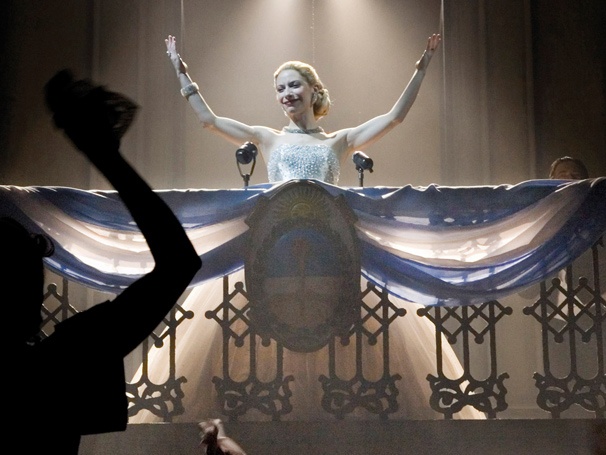
Image c/o googleimages.com
As far as other gripes go, there was a major lack of narrative. They were highlighting moments of Evita's life rather than giving a fluid story, which was confusing (to the point where I thought she was a promiscuous person, not a paid prostitute, for a good portion of the show). Also, I was not at all impressed with Ricky Martin, although Greg was raving about his performance. And, about singing everything, I'm not a huge fan of that, either. Apparently, Evita is marketed as a "rock-musical" (bad bad bad bad idea), which puts the show in the tradition of Rent, Spring Awakening, and Next to Normal. Audiences who are not comprised entirely of angsty, fifteen-year-old girls will probably find the style of all of these shows to be really terrible, as they should. 
Image c/o googleimages.com
Now that I've complained extensively about the show, I guess I should admit that I didn't hate it. In the end, I walked away with an absolute fascination with Eva Peron, who I knew nothing about prior. I've already read her entire Wikipedia page and will probably take out a few books on her life because I'm confused, and intrigued, and amazed. And I think that's exactly what the show was trying to do.

Monday, February 13, 2012

The Good Ol' Days

I tend not to be nostalgic. But, when Nicki Minaj was "exorcised" at the Grammy's last night, it was hard for me not to yearn for better days. Rather than gluing my eyes to her levitating body, I took a stroll into the history of Grammy's of yore to find respite.
This is terrifying! And not in a fun way.
Image c/o googleimages
The first Grammy awards, originally called the Gramophone awards, were held on May 4, 1959. Domenico Modugno took both Best Record and Best Song of the year. Perhaps more familiar to our twenty-first-centurion ears, the Chipmunks also brought home an award, as did jazz superstar Ella Fitzgerald. Music Man won Best Original Cast Album. And, if only out of pity, the red-nosed, half-lit picture of Frank Sinatra on the face of Frank Sinatra Sings Only for the Lonely won Best Album Cover Photography.
Sad Sinatra is STILL more aesthetically
pleasing than Nicki Minaj
Photo c/o googleimages
Even with its tinges of pathetic, I'd take the portrait of sad Sinatra over a performance of maniacal Minaj any day. It may be easy to view the past with rose-colored glasses, but the ceremony back then really did seem to be easier on the ears, and on the eyes. After all, at the Grammy's of 1959, there were no crimped, blue-haired wigs. No barely-there lace kimonos. No black, birdcage veiled, golden-sceptered, half-black-haired queen. No levitating, pink-lipsticked, little-red-riding-hood-with-the-pope-for-a-date....alright, I give up, this is ridiculous!
Domenico Modugno at the Grammy's,
back when they were classy.
Photo c/o googleimages
In celebration of the Grammy's 1959-style, I've been jamming to Nel Blu Dipinto di Blu (Volare). It's a simple song about the highs of love, accompanied by the visual high of Modugno's adorable 'stache. I can't get enough of it. Compared to the 2012 Grammy's hulabaloo, the Grammy's of yesteryear offer simple, and welcome, perfection.

Monday, February 6, 2012

Love, Loss, and What I Wore

Love, Loss, and What I Wore puts love and loss at center stage. The show features four women who go through multiple marriages, come out, lose their mothers at young ages, get raped, and more: all of life's worst bestowed on this small sample population. Veanne Cox and Lillias White deliver convincing performance, but the show's handicap is in the script, not the acting. While the actresses harp on their crises, the audience craves meaning in stability.

Perhaps the "what I wore" aspect of the show is meant to deliver the consistency so lacking in the leads' lives. However, the joyful, creative element of style is reduced to superficiality as the women put so much emphasis on that wrap dress or those suede boots. After sitting through one too many monologues about a purse, it behooves the audience to ask why the people in their lives then aren't given as much value as the material things these women adore. We yearn to see their fashion-centered romance and devotion play out in their human relationships, we hope that the play will conclude on this happy high, but such affection never leaves Filene's Basement.

Surely, the goal of Love, Loss, and What I Wore is not to expose a bunch of superficial ladies who have their priorities screwed up. It probably hopes to empower women. However, LLWW forgets that empowerment is a human phenomenon, one that requires a lot more than the occasional mention of fashion.

Monday, August 8, 2011

London Pride


As I boarded my flight to London with fourth-of-July fireworks still ringing in my ears, it occurred to me that England does not have an independence day. “No,” said the woman next to me on the plane, who was, by chance, a Londoner, “we’re the ones who gave everyone else their independence.”